Senin, 30 April 2012

What is the minimal webmaster competence for running a medical blog?

"What is the minimal webmaster competence for running a medical blog?", asked a relatively new blogger recently. My suggestions are listed below.

Keep it simple, and free

If your blog content is great and compelling, you don't need much HTML, CSS, etc. knowledge. Knowing HTML doesn't hurt, of course, but it's not essential.

Keep it simple, and free. Many doctors are wrongly advised to spend time and money on custom installations of WordPress, hosting, and social media consultatants when all they need is a free Google/Blogger blog with a custom domain name.

"Blogging is teaching, whether it’s yourself or others, and that’s the best feeling in the world" 

Speaking from personal experience, my blogs reached more than 8 million page views and I've never used outside help for blog launch or maintenance. I don't think my blog content is that great or original apart from a few mind map diagrams, mnemonics and social media how-to articles - it's just my personal digital netbook that I share with the world.

I typically publish one post per day during the week at CasesBlog and AllergyNotes. They are scheduled 2-3 months in advance, and publish automatically, unless I edit them the day before they are due for posting.

"Blogging is teaching, whether it’s yourself or others, and that’s the best feeling in the world" http://goo.gl/hCpF8

Comments from Google Plus and Twitter:

Ahmad Gandour, Jan 25, 2012: This is a great advice i will consider starting a blog in the near future .you really post interesting post i check your post every day in the morning while i am checking journal watch and BEJM news letter thanks for these great post .

Ves Dimov, M.D., Jan 25, 2012: Thank you for your interest. I typically publish one post per day during the week at CasesBlog and AllergyNotes. They are scheduled 2-3 months in advance, and publish automatically, unless I edit them the day before they are due for posting.

Ahmad Gandour, Jan 25, 2012: Thanks for the info i booked marked the both pages i am going to check it every day

Ves Dimov, M.D., Jan 25, 2012: You can subscribe to the RSS feeds - this way there is no need to visit the website every day - the new post gets delivered to your RSS reader (Google Reader) or email.

Ahmad Gandour, Jan 25, 2012: Done :)

Jill Celeste, Jan 25, 2012: Blogger is the perfect tool for a doctor. Great post!

Heidi Allen @dreamingspires: What is the minimal webmaster competence for running a medical blog? casesblog.blogspot.com/2012/04/what-i… Keep it simple and free. Teach yourself and others

Minggu, 29 April 2012

Top articles in medicine in April 2012 (part 3)

Here are my suggestions for some of the top articles in medicine in April 2012:

Botulinum Toxin for Prophylaxis of Migraine and Tension Headaches: not so great - JAMA http://j.mp/IecqxB

Varicocele Is Associated with Erectile Dysfunction: 3.3% of ED patients have it vs. 1.2% of controls http://goo.gl/R8nPi

Evaluation of nail abnormalities: subungual melanomas, account for 50% of melanomas in persons with dark skin http://goo.gl/ryWVo

Sunscreens & Vitamin D: the overwhelming majority of dermatologists recommend to get your vitamin D from food, not from the sun http://goo.gl/BcFtP

Heat waves that last for more than a week can be deadly, particularly for the elderly. For every 1 degree C increase in summer temperature, death risk of the elderly with chronic conditions rises 3-4% http://goo.gl/2sYh1

Personal vs. Professional: How Doctors Manage Their Social Media Profiles - University of Chicago Medicine blog http://goo.gl/JNyu1

45% of women overestimate the effectiveness of the Pill and condoms for pregnancy prevention (study) http://goo.gl/1QcXW

FDA approves fast-acting Viagra rival: Avanafil (Stendra) starts working in 15 min, the fastest of the 4 ED drugs http://goo.gl/Joskq

More than 40% of people in the U.S. live in counties with unsafe levels of air pollutants http://goo.gl/G2bG8

20% of Americans have gone out on a date with someone they met online. New to Online Dating: Here are 11 Tips http://goo.gl/ulviK

Most Peaceful, Least Peaceful U.S. States - For 11th year in a row, Maine is the most peaceful state in America http://goo.gl/ZTr4X

Damage control on physician-rating websites - "We've all got a megaphone now," says CEO of physician-rating site http://goo.gl/ouxiI

7 steps to responding to angry patients - "RAPSAND" acronym builds "emotional muscle" in staff members http://goo.gl/IXcWP

The articles were selected from my Twitter and Google Reader streams.

Sabtu, 28 April 2012

Top articles in medicine in April 2012

Here are my suggestions for some of the top articles in medicine in April 2012:

Rise in Scientific Journal Retractions Prompts Calls for Reform - NYTimes http://goo.gl/6qB8H. The higher a journal’s impact factor, the higher its retraction rate. The highest “retraction index” naturally belongs to NEJM. Retractions are “a symptom of a dysfunctional scientific climate”. Each year, every laboratory produces a new crop of Ph.D.’s, who must compete for a small number of jobs, and the competition is getting fiercer. In 1973, more than half of biologists had a tenure-track job within six years of getting a Ph.D. By 2006 the figure was down to 15 percent. Yet labs continue to have an incentive to take on lots of graduate students to produce more research (“pyramid scheme”).

Harvard University says it can't afford journal publishers' prices: $3.5m a year, 145% increase over 6 years http://goo.gl/tlxWP

Warren Buffett may be the richest man in America, but he appears to be getting the poorest medical advice. In medicine, "watchful waiting" is now called "active surveillance with delayed intention to treat" - Harvard http://hvrd.me/JsK3vK

Lab Testing in Erectile Dysfunction: glucose, testosterone, prolactin, and lipid profile may reveal comorbidities http://goo.gl/MdBrn

75% of diabetics who had gastric bypass surgery no longer were diabetic after 2 years. Bariatric surgery costs $18,000-35,000 without insurance - for those with coverage, $5,000 deductibles are common j.mp/Ie0xYl

30% of U.S. workers are not getting enough sleep - 41 million sleep 6 or fewer hours putting the public at risk http://goo.gl/mnQJg

Survey lists "Best Paid and Worst Paid Doctors". Only 11% of U.S. doctors consider themselves rich. 45% of doctors think: "My income probably qualifies me as rich, but I have so many debts and expenses I don't feel rich." http://goo.gl/a5gq8

Among children and adolescents in a low-income, urban area, text messaging increased rate of influenza vaccination http://goo.gl/waznJ

Most major British universities are paying £4-6 million a year to journal publishers like Elsevier, Springer, etc. Most publishers have to pay for content they publish. Not journal publishers. Content is provided free by researchers. The peer reviewing that ensures quality of publications is provided free (value of UK unpaid peer reviewing is £165m) http://bit.ly/HYzonu

The articles were selected from my Twitter and Google Reader streams.

Jumat, 27 April 2012

Diabetes drug injected once a week gets F.D.A. approval: Bydureon (long-acting exenatide)

From the NYTimes:

The FDA twice declined to approve long-acting exenatide (Bydureon) in 2010, with its most serious concern being that the drug might contribute to heart rhythm abnormalities. There are safety concerns involving thyroid cancer and pancreatitis.

Bydureon is a longer-lasting version of Amylin’s existing drug Byetta, which is injected twice a day. Another company, Alkermes, supplied the technology that slowly releases Bydureon inside the body.

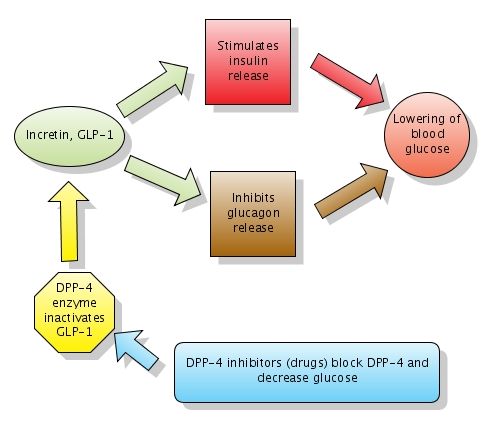
Bydureon, Byetta and Victoza are drugs called GLP-1 receptor agonists, which mimic the effect of glucagonlike peptide- 1, a hormone that increases insulin production when blood sugar is high.


Figure: Action of DPP-4 inhibitors. Note that DPP-4 normally inactivates GLP-1. DPP-4 inhibitors block DPP-4 which in turn leaves GLP-1 active. Click to enlarge the figure. I made the figure with Gliffy in 2006 . The diagram Action of DPP-4 inhibitors is now widely used in many articles on Wikipedia, with my permission.

The main ingredient in both Bydureon and Byetta is exenatide, a hormone derived from the saliva of the Gila monster, a poisonous lizard found in the Southwestern United States and Mexico.

Wholesale price of Bydureon would be $323 for 4 doses, or about $4,200 a year. That is between the roughly $3,400 for the low dose of Victoza and $5,000 for the high dose.

References:

Diabetes Drug Injected Weekly Wins F.D.A. Approval. NYTimes.

Comments from Twitter:

Vaughn Eyvazian @Vaughnsays: Increase that pt compliance!

Reinaldo B. @basanezrx: but nobody stays in the lowest dose of Victoza in my experience, and that's why most ins companies pay for Byetta instead. A shame :(

Kamis, 26 April 2012

6 Reasons Why Doctors Blog

Here are the 6 Reasons Why Doctors Blog, according to Dr. John M., a cardiologist and electrophysiologist:

Here are the top six reasons why I and other doctors choose to author medical blogs:

1. The Practice of Medicine inspires
2. To educate
3. To better mankind
4. To give a look behind the curtain
5. To archive useful information
6. To display our humanness

My comment is here:

Thank you for the wonderful post and sharing insights, John.

Blogging "To better mankind" is beyond reach for me, I think. However, I hope that my blogs helped "To educate" at least some of the readers who flipped through more than 8 million pages since 2005...

Doctors are highly-qualified experts who limit their impact only to patients they see - if they don't publish, give lectures - and blog. In most cases, benefits far outweigh the risk and doctors should be encouraged to at least give it a try.

I tried to describe a practical and time-efficient approach here:

Social media in medicine: How to be a Twitter superstar and help your patients and your practice
http://casesblog.blogspot.com/2011/10/social-media-in-medicine-how-to-be.html

Blogging also keeps you grounded and humble. Critical comments prompt you to back your clinical opinion, expressed in a blog post, with solid scientific references and that's a good thing.

Comments from Google Plus:

Gary Levin, Jan 22, 2012: Ves, I agree with all of the above and welcome to G+ Let's hangout sometime soon. I will send you an invite..

Sherri Vance, Jan 22, 2012: Dr. Ves, I love your blogs. As for reasons why MDs should blog, I think the view behind the curtain (#4) is the most important. Given that our nation is weighing a myriad of conflicting viewpoints on how to fix our healthcare system, understanding these issues from the doctor's viewpoint is vital. Thanks! 

Carlo V Caballero-Uribe, Jan 26, 2012: Excelllent. I am sharing this post with my residents and students. They will discuss about it in a seminar. Many of #hscm its centered on engagement with patients and public its ok but engagement with your students and peers in several ways that social media offers its very important

As some example some of our use include:
Twitter for journal clubs
Google plus circles to clinical cases discussions
Google docs to edit papers
Slideshare for seminars presentations
Below in the link its a post about it in my blog. Sorry its in spanish but the translator helps.
Thanks for your posts and example.

http://carvica1.blogspot.com/2011/12/como-podemos-usar-las-redes-sociales-en.html

Rabu, 25 April 2012

Children’s ability to "roam" has been destroyed, and they congregate on social media sites

From the the NYTimes:

Danah Boyd, a senior researcher at Microsoft and an assistant professor at New York University: “Children’s ability to roam has basically been destroyed. Letting your child out to bike around the neighborhood is seen as terrifying now, even though by all measures, life is safer for kids today.”

Children naturally congregate on social media sites for the relatively unsupervised conversations, flirtations, immature humor and social exchanges that are the normal stuff of teenage hanging-out, she said.

Moreover, grown-ups’ panic about teenage online behavior distracts from the potential benefits.

Let kids be kids - unstructured play time may be more important than homework, suggests a childhood psychologist. "Children have lost 8 hours per week of free, unstructured, and spontaneous play over the last 2 decades due to homework. Decrease in unstructured play time is in part responsible for slowing kids’ cognitive and emotional development. Today’s 5-year-olds had the self-regulation capability of a 3-year-old in the 1940s; the critical factor seems to have been not discipline, but play."

Video: A life cycle in 90 seconds:


References:

Cracking Teenagers’ Online Codes. NYTimes, 2012.

Image source: OpenClipArt.org, public domain.

Selasa, 24 April 2012

Unfaithfulness in men may be associated with higher risk of cardiovascular events

The authors of this study from Italy performed an extensive Medline search for “unfaithfulness,”“extramarital affairs,”“infidelity,” and “men.”

How common is unfaithfulness in men?

As expected the results were variable. Some surveys reported that 1.5–4% of married men had extramarital coitus in any given year, others that 23.2% of men have cheated during their current relationship.

Lifetime prevalence of unfaithfulness was between 15% and 50%.

What are the factors related to unfaithfulness?

Men with extramarital affairs more frequently have a dysfunctional primary relationship.

Parenthood and conflicts within the family are associated with a higher risk of having an affair.

Unfaithful men display a higher androgenization, larger testis volume, higher sexual desire, and better sexual functioning.

What are the clinical implications of unfaithfulness in men?

Some studies have suggested that having an extramarital affair could have a negative impact on cardiac morbidity and mortality. Unfaithfulness in men seems to be associated with a higher risk of major cardiovascular events.

References

Fisher AD, Bandini E, Rastrelli G, Corona G, Monami M, Mannucci E, and Maggi M. Sexual and cardiovascular correlates of male unfaithfulness. J Sex Med, 2012.

Image source: OpenClipart.org, public domain.